Did you know that early humans survived the harsh wilderness by living in caves before they discovered how to build their own homes? Or imagine if you lived in the freezing Arctic region, where your entire house, called an igloo, was constructed purely out of large square pieces of solid ice! In this exploration of Housing and Clothing, we will decode the incredible evolution of human shelter and attire. We will travel back to the Stone Age, where the very first clothes were stitched using primitive needles made from bones. We will uncover the architectural secrets of why houses in cities are pucca houses made of bricks, iron, and cement, while those in heavy rainfall areas are elevated on stilts. Get ready to discover the science behind a well-ventilated home, how proper sunlight acts as a natural destroyer of germs, and the climate logic dictating whether we wear light cotton clothes or heavy woollen clothes!
2. Real-World Lesson (Why This Matters)
Understanding the foundational principles of housing and clothing is essential for human survival, urban planning, and daily health management. In real life, knowing how to build an ideal house with a proper drainage system and covered drains directly prevents the breeding of mosquitoes and flies, safeguarding modern society from dangerous diseases. Furthermore, adapting our architecture to the environment—such as building sloping roofs in mountainous regions to let snow and rainwater slide off—prevents structural collapse and property damage. On a personal level, choosing the correct clothing based on climate is a crucial life skill; for instance, wearing light cotton clothes in summer prevents the skin from getting burned by the sun, while wearing gumboots during the rain protects feet not just from water and mud, but from dangerous sharp objects.
3. The Exhaustive Sequence / Process / Timeline
Phase 1: The Historical Evolution of Human Shelter and Clothing
- Early Human Era: Early humans initially lived in caves to protect themselves from the elements and wild animals.
- Material Discovery: Gradually, early humans discovered construction materials such as stone, wood, bamboo, straw, and mud, which allowed them to begin building proper houses.
- Stone Age Clothing Innovation: During the ‘Stone Age’, humans began manufacturing their own clothes using needles that were made directly from bones.
Phase 2: Architectural Classification of Houses
- Purpose: A house is built to protect humans from rain, storm, the heat of the Sun, thieves, and wild animals, keeping them safe and comfortable.
- Core Anatomy: Every house consists of a roof or ceiling that covers it, walls, many rooms, at least one door per room, and windows.
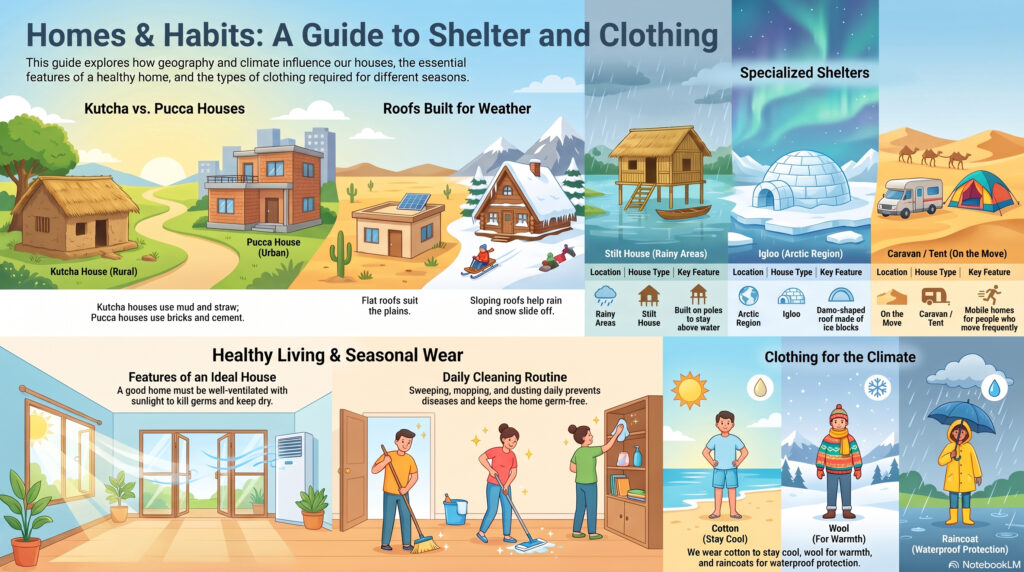
- Rural Construction: Houses in rural areas are predominantly kutcha houses, constructed using straw, mud, and sticks.
- Urban Construction: Houses in cities and towns are pucca houses, built using durable materials like bricks, iron, and cement.
- High-Rainfall Adaptation: In regions experiencing heavy rainfall, houses are elevated and built on poles known as stilts.
- Nomadic Habitats: Nomads, who do not stay in one place for a long time, live in mobile shelters like tents and caravans.
- Arctic/Eskimo Habitats: In the Arctic region, Eskimos live in igloos, which are constructed from large square pieces of ice blocks.
Phase 3: The Science of Roof Design
- The type of roof on a house depends strictly on the weather of the location.
- Plains: Most houses feature flat roofs made of materials like cement and iron.
- Mountains/Heavy Rainfall/Snowfall: Houses feature sloping roofs to allow rainwater and snow to slide off easily.
- Igloos: Feature a specific dome-shaped roof.
Phase 4: Designing the Ideal House
- Spatial Division: An ideal house contains separate rooms designated for specific activities: a kitchen for cooking food, a drawing room for receiving guests, a bedroom for sleeping and resting, and a study room for studying.
- Ventilation & Light: Every room must have many windows and be well-ventilated. Proper sunlight is mandatory to keep the rooms dry and free from germs.
- Open Spaces: An ideal house must include open spaces, like a veranda or courtyard, to provide fresh air and sunlight.
- Sanitation/Drainage: Bathroom and kitchen floors must be well-sloped so that water flows out effortlessly. A proper drainage system with covered drains is required to keep mosquitoes and flies away.
- Environment: The house requires a proper water supply in the kitchen, bathrooms, and toilets. Plants should be grown around the house because they keep the air clean and add beauty to the surroundings.
Phase 5: Daily Cleaning Process & Disease Prevention
- Living in a dirty house may cause many diseases, necessitating strict daily hygiene protocols.
- Floors: The floors of the house must be swept and mopped every day.
- Sanitary Fixtures: Washbasins, bathrooms, and toilets must be washed and cleaned every day.
- Dusting: Everything in the house must be dusted daily to remove the dust brought in by the air.
- Drain Maintenance: Drains must be cleaned specifically twice a day using germ-killers.
- Waste Management: Garbage must always be thrown into dustbins.
- Maintenance: The walls and floors of the house should be well-maintained.
- Curtain Utilization: Curtains should be used on doors and windows because they add beauty, keep dust out, and protect from heat and light during summers. Curtains must also be kept clean.
Phase 6: The Mechanics of Clothing and Climate
- General Purpose: Clothes make people look smart and protect them from dust, heat, cold, rain, insect bites, and prevent skin from getting burned when staying in the Sun for a long time.
- Summer Climate: Humans wear light cotton clothes to keep cool and protect against the heat of the Sun.
- Winter Climate: Humans wear woollen clothes to retain heat and keep themselves warm.
- Rainy Climate: Humans wear raincoats and carry umbrellas to prevent getting wet. Gumboots are worn to provide protection against water and mud, and critically, to protect feet from sharp objects.
4. Comprehensive Vocabulary (The Word List)
- [Ceiling] – [The top of the house] – [Used to describe the upper covering that roofs a house].
- [Kutcha house] – [A house made of straw, mud, and sticks] – [Used to classify the typical houses built in rural areas].
- [Pucca house] – [A house made of bricks, iron, and cement] – [Used to classify the durable houses built in cities and towns].
- [Stilts] – [Posts that support a building so that it is high above the ground or water] – [Used to describe how houses are elevated in places where it rains a lot].
- [Nomads] – [People who do not stay at one place for a long time] – [Used to describe individuals who move around and live in tents and caravans].
- [Caravan] – [A mobile shelter] – [Used alongside tents to describe the homes of nomads who move from place to place].
- [Igloo] – [A house made of ice blocks] – [Used to describe the dome-roofed shelters built by Eskimos in the Arctic region].
- [Well-ventilated] – [Airy or having fresh air entering and moving around] – [Used to describe an essential feature for every room in an ideal house].
- [Germs] – [Very small living beings that cause diseases] – [Referenced as harmful organisms that proper sunlight destroys and that require germ-killers to eliminate in drains].
- [Dustbins] – [Containers in which we throw garbage] – [Used in the context of maintaining a clean and disease-free house].
- [Mopped] – [To clean a floor with water and a cloth] – [Used to describe the daily cleaning routine required for the floors of a house].
- [Gumboots] – [Protective footwear for rain] – [Used to describe footwear that protects against water, mud, and sharp objects].
5. Teacher’s Chapter Checklist
- [ ] Concept 1: The Function of a House: Teach that houses protect humans from rain, storm, sun heat, thieves, and wild animals.
- [ ] Concept 2: Basic House Anatomy: Identify core parts including the roof/ceiling, windows, rooms, doors, and walls.
- [ ] Concept 3: Classification of Houses: Differentiate clearly between Kutcha houses (straw/mud/sticks, found in rural areas) and Pucca houses (bricks/iron/cement, found in cities).
- [ ] Concept 4: Geographic & Lifestyle Adaptations: Explain Stilt houses (heavy rain), Igloos made of ice blocks (Arctic region/Eskimos), and Tents/Caravans (Nomads).
- [ ] Concept 5: Roof Architecture: Correlate weather to roof design: Flat roofs (plains, made of cement/iron), Sloping roofs (mountains/heavy rain/snow to let elements slide off), and Dome-shaped roofs (igloos).
- [ ] Concept 6: Anatomy of an Ideal House: Map out the spatial division (kitchen, drawing room, bedroom, study) and mandate elements like sunlight (to keep dry/free from germs), open space (veranda/courtyard), and ventilation.
- [ ] Concept 7: Sanitation & Plumbing Rules: Emphasize well-sloped floors for bathrooms/kitchens, proper water supply, and covered drains to keep mosquitoes/flies away.
- [ ] Concept 8: Strict Hygiene Protocols: Teach the daily cleaning regimen: sweeping/mopping floors, cleaning washbasins/toilets daily, dusting daily, and cleaning drains twice a day with germ-killers.
- [ ] Concept 9: Historical Context: Highlight that early humans survived in caves before discovering building materials, and that Stone Age humans made clothes using bone needles.
- [ ] Concept 10: The Purpose and Climate Adaptations of Clothing: Explain that clothes protect from dust, heat, cold, rain, insect bites, and sunburn. Categorize seasonal wear into Summer (light cotton clothes), Winter (woollen clothes), and Rain (raincoat, umbrella, gumboots to protect from sharp objects).
6. Ready-Reckoner Student Revision Notes
UNIT OVERVIEW: HOUSING AND CLOTHING
1. WHY DO WE NEED A HOUSE?
- A house protects us from rain, storm, the heat of the Sun, thieves, and wild animals.
- It keeps us safe and comfortable.
- Historical Fact: Early humans used to live in caves to protect themselves. Later, they discovered stone, wood, bamboo, straw, and mud to build proper houses.
2. PARTS AND TYPES OF HOUSES
- Basic Parts: A house consists of a roof (or ceiling), walls, doors, windows, and many rooms.
- Kutcha Houses: Found in rural areas. They are made of straw, mud, and sticks.
- Pucca Houses: Found in cities and towns. They are made of bricks, iron, and cement.
- Stilt Houses: Found in places where it rains a lot. These houses are built on high poles called stilts.
- Mobile Houses: People who move from place to place are called nomads. They live in tents and caravans.
- Igloos: Found in the Arctic region. Eskimos live in these houses made of large, square pieces of ice blocks.
3. TYPES OF ROOFS
- Flat Roofs: Found in the plains. Made of cement, iron, etc..
- Sloping Roofs: Found in places with heavy rainfall, snowfall, or on mountains. The slope helps water and snow slide off easily.
- Dome-shaped Roofs: Found specifically on igloos.
4. FEATURES OF AN IDEAL HOUSE
- Separate Rooms:
- Kitchen: For cooking food.
- Drawing Room: For receiving guests.
- Bedroom: For sleeping and resting.
- Study Room: For studying.
- Ventilation and Sunlight: Rooms must be well-ventilated (airy). Proper sunlight keeps the rooms dry and free from germs.
- Open Spaces: Should have a veranda or courtyard for fresh air and sunlight.
- Proper Drainage: Bathroom and kitchen floors must be well-sloped so water flows out easily. Drains must be covered to keep mosquitoes and flies away.
- Greenery: Plants should be grown around the house to keep the air clean and add beauty.
- Water: Must have a proper water supply in the kitchen, bathrooms, and toilets.
5. HOW TO KEEP A HOUSE CLEAN
Living in a dirty house causes many diseases. You must follow these rules:
- Every Day: Sweep and mop the floors. Wash and clean washbasins, bathrooms, and toilets. Dust everything to remove dust brought in by the air.
- Twice a Day: Clean the drains using germ-killers.
- Garbage: Always throw garbage into the dustbins.
- Curtains: Use curtains on doors and windows to keep dust out. In summer, curtains protect from heat and light.
6. ALL ABOUT CLOTHING
- Why we wear clothes: They make us look smart and protect us from dust, heat, cold, rain, insect bites, and sunburn.
- Historical Fact: In the Stone Age, humans made clothes using needles made from bones.
- Summer Clothes: We wear light cotton clothes to keep us cool and protect us from the Sun’s heat.
- Winter Clothes: We wear woollen clothes to keep ourselves warm.
- Rainy Clothes: We wear a raincoat and carry an umbrella to avoid getting wet. We also wear gumboots to protect against water, mud, and sharp objects.
QUESTIONS
1. The “Hidden” In-Text Questions (Mid-Chapter Extraction)
Q1. Based on the “Jump Start” section, what is the term used for mobile houses that move around from place to place?
Q2. According to the “Parts of a House” section, what is the absolute minimum number of doors that every room in a house must possess?
Q3. Referencing the “Fact Flash” in the houses section, what specific natural shelters did early humans live in before they discovered how to build proper houses?
Q4. According to the “Roofs of Houses” section, what specific type of roof is constructed on houses in places that experience heavy rainfall or snowfall, and what is its functional purpose?
Q5. Based on the “An Ideal House” section, why must the floors of the bathroom and the kitchen be well-sloped?
Q6. According to the “A Clean House” section, exactly how many times a day should drains be cleaned, and what specific substance should be used?
Q7. Referencing the “Why Do We Need Clothes?” section, what biological consequence can occur to human skin if people stay in the Sun for a long time without protective clothing?
Q8. Based on the “Fact Flash” in the clothing section, what specific material did humans during the ‘Stone Age’ use to make their needles for clothing?
2. The Textbook Exercise Integration (Back-of-Chapter)
Let’s Say Give one word answer.
- We must keep our house clean to stay ______
- The houses found in rural areas are mostly ______
- Igloos are made of ______
Let’s Write A. Tick () the correct option.
- Houses in rural areas are generally made of: (a) Steel (b) Iron (c) Brick (d) Mud
- An igloo has a: (a) Flat roof (b) Sloping roof (c) Dome-shaped roof (d) No roof
- An ideal house has many: (a) Rooms (b) Doors (c) Windows (d) All of these
- In winter, we wear ______ clothes to keep ourselves warm. (a) Woollen (b) Cotton (c) Nylon (d) All of these
B. Fill in the blanks using the words from the help box. (cotton, swept, mopped, curtains, climate)
- The floors of the house should be ______ and ______ everyday.
- ______ on the windows keep the dust away.
- People wear clothes according to the ______.
- We should wear ______ clothes in summer.
C. Write ‘T’ for true and ‘F’ for false statements.
- Bathrooms should be cleaned regularly.
- Garbage should be kept in the kitchen.
- Bathroom floors should not be sloped so that water stagnates there.
- Flat roofs are made of cement, iron, etc.
D. Match the columns. Column A:
- Nomads
- Rural areas
- Summer
- Winter Column B: (a) Woollen clothes (b) Caravan (c) Kutcha house (d) Cotton clothes
E. Answer the following questions.
- Why do we need a house? List three features of an ideal house.
- Write two ways by which a house can be kept clean.
- Why do we wear a raincoat?
- What are the different types of clothes?
F. Name two things that are essential in each of the following.
- Kitchen
- Drawing room
- Bedroom
- Bathroom
Mind Maze [HOTS]
- Why should we plant trees around our houses?
- How can you maintain hygiene through clothing?
Life Skills (Critical Thinking) Do you help your parents and siblings in keeping your home clean? Keeping our home and surroundings neat and clean should be our duty as clean surroundings keep us healthy and happy. Moreover, it gives our home a cheerful look. Now, answer this: If yes, what is your contribution to keeping your home and surroundings clean?
Project/Activity (Research and Enquiry Skills/Creative Thinking)
- Draw pictures of three different kinds of houses and the places where they are found in the space given below: (a) (b) (c)
- Find out about different types of textiles such as jute, linen, rayon, poplin, lycra, velvet, georgette, etc. available in the market with the help of your family members. Now, categorise them according to the seasons in which we wear them.
Junior Scientist (Experiential Learning)
- Make a mud house with clay. Fix grass or leaves on top to create a sloping roof.
- Collect pictures of different types of clothes and paste them on a chart along with their names.
3. Exhaustive Objective Bank (The Factual Baseline)
Multiple-Choice Questions (MCQs)
Q9. What does a house primarily protect us from according to the text? A) Traffic and noise B) Rain, storm, the heat of the Sun, thieves, and wild animals C) Neighbors D) Dust only
Q10. What covers the top of a house? A) The floor B) The roof or ceiling C) The window D) The stilts
Q11. What materials are primarily used to construct a kutcha house? A) Bricks, iron, and cement B) Straw, mud, and sticks C) Ice blocks D) Cloth and poles
Q12. Where are pucca houses mostly found? A) In rural areas B) On mountains C) In cities and towns D) In the Arctic region
Q13. Why are houses built on stilts in certain areas? A) Because it snows heavily B) Because it rains a lot C) To protect against high winds D) To prevent ice from melting
Q14. What do we call people who do not stay at one place for a long time? A) Eskimos B) Farmers C) Nomads D) Builders
Q15. Which of the following is a mobile shelter used by nomads? A) Igloo B) Caravan C) Pucca house D) Stilt house
Q16. What materials did early humans discover to build proper houses after living in caves? A) Bricks, cement, and iron B) Glass and plastic C) Stone, wood, bamboo, straw, and mud D) Ice and snow
Q17. In the plains, what type of roofs do most houses have? A) Flat roofs B) Sloping roofs C) Dome-shaped roofs D) Stilt roofs
Q18. What kind of roof does an igloo have? A) Sloping roof B) Flat roof C) Dome-shaped roof D) Wooden roof
Q19. Which room in an ideal house is specifically designated for receiving guests? A) Bedroom B) Kitchen C) Study room D) Drawing room
Q20. What is the benefit of having proper sunlight in the rooms of an ideal house? A) It makes the room colorful B) It keeps the rooms dry and free from germs C) It cools the house down D) It keeps thieves away
Q21. Why should a proper drainage system have covered drains? A) To keep water flowing fast B) To keep mosquitoes and flies away C) To make the floor look neat D) To block the smell of mud
Q22. What must be thrown into dustbins to keep a house clean and germ-free? A) Dirty clothes B) Germ-killers C) Garbage D) Neem twigs
Q23. According to the text, what is a primary function of using curtains on doors and windows during the summer? A) To absorb water B) To protect us from heat and light C) To keep the floor sloped D) To allow germs to escape
Q24. Why do we wear clothes in general? A) To make us run faster B) To protect us from dust, heat, cold, rain, and insect bites C) To make it easier to swim D) Only for looking smart
Q25. Which type of clothing is recommended for the summer climate to keep us cool? A) Light cotton clothes B) Heavy woollen clothes C) Raincoats D) Nylon clothes
Q26. What is the purpose of wearing woollen clothes in the winter? A) To protect from rain B) To keep ourselves warm C) To reflect the Sun’s heat D) To stop insect bites
Q27. Aside from protecting against water and mud, what else do gumboots protect our feet from? A) Cold winds B) Sunburn C) Sharp objects D) Mosquitoes
Q28. What did humans use to make needles during the ‘Stone Age’? A) Iron B) Bones C) Wood D) Stone
Q29. What is the scientific term used in the text to describe very small living beings that cause diseases? A) Nomads B) Insects C) Dustbins D) Germs
Fill-in-the-Blanks
Q30. A house protects us from rain, storm, the heat of the Sun, thieves and ______ animals.
Q31. The houses found in rural areas are mostly ______ houses.
Q32. In cities, houses are made of bricks, iron and ______.
Q33. Houses on mountains are constructed with ______ roofs so that snow and rainwater slide off easily.
Q34. The people of the Arctic region live in houses made of ice blocks called ______.
Q35. Early humans used to live in ______ to protect themselves before they discovered building materials.
Q36. An ideal house should have some open space, like a veranda or a ______, to provide fresh air and sunlight.
Q37. The floors of the bathroom and the kitchen should be well-sloped so that ______ flows out.
Q38. Living in a dirty house may cause many ______, so the house should be kept clean.
Q39. The floors of the house should be swept and ______ every day.
Q40. Drains should be cleaned ______ a day using germ-killers.
Q41. When people stay in the Sun for a long time, their ______ can get burned.
Q42. In winter, we wear ______ clothes to keep ourselves warm.
Q43. We wear ______, which provide protection against water, mud, and sharp objects.
Q44. In the ‘Stone Age’, humans began to make clothes using ______ made from bones.
True/False Questions
Q45. True/False: An ideal house only needs one large room for cooking, sleeping, and receiving guests. (If False, correct the statement)
Q46. True/False: Houses found in cities and towns are called kutcha houses. (If False, correct the statement)
Q47. True/False: Stilt houses are built on poles in places where it rains a lot. (If False, correct the statement)
Q48. True/False: Nomads are people who live in the same pucca house for their entire lives. (If False, correct the statement)
Q49. True/False: Most houses in the plains have flat roofs made of cement and iron. (If False, correct the statement)
Q50. True/False: A well-ventilated room means it has fresh air entering and moving around. (If False, correct the statement)
Q51. True/False: Plants should be grown around the house because they help keep the air clean and add beauty to the surroundings. (If False, correct the statement)
Q52. True/False: You only need to dust the items in your house once a week to remove dust. (If False, correct the statement)
Q53. True/False: Curtains should be kept on windows because they keep dust out and protect from heat and light. (If False, correct the statement)
Q54. True/False: Light cotton clothes are primarily worn in the winter to trap body heat. (If False, correct the statement)
4. Subjective & Competency Bank (Higher-Order Thinking)
Short-Answer Questions
Q55. Why do we need a house, according to the text’s primary explanation?
Q56. Explain the difference between a kutcha house and a pucca house based strictly on the materials used to build them.
Q57. How do the roofs of houses in the plains differ from those on mountains, and what is the functional reason for this difference?
Q58. Explain who nomads are and name two specific types of shelters they live in.
Q59. Why did early humans live in caves before they learned to build proper houses, and what materials did they eventually discover?
Q60. Explain the two specific benefits of allowing proper sunlight to enter an ideal house.
Q61. Why is it necessary for a house to have a proper drainage system with covered drains?
Q62. Explain the daily cleaning routine required for the floors, washbasins, and toilets to keep a house free of diseases.
Q63. Why do we wear light cotton clothes in summer rather than woollen clothes?
Q64. Explain the three specific protective benefits of wearing gumboots during the rainy season.
Scenario-Based / Competency Questions
Q65. If you were planning to build a house in an area that experiences heavy and continuous rainfall, what specific architectural feature must you use for the foundation, and what type of roof must you build?
Q66. You are a researcher moving to the Arctic region; based on the chapter, what specific type of shelter will you encounter, and what unique material is it constructed from?
Q67. Your friend’s house has flat bathroom floors that collect water and uncovered drains in the kitchen; explain the specific health risks associated with this design flaw according to the text.
Q68. During a hot summer day, a student decides to stand in the sun wearing thick woollen clothes; based on the text, what two specific risks is the student facing regarding their skin and body temperature?
Q69. A family is designing their ideal house and wants to ensure fresh air and natural light constantly enter the home; what three specific architectural features or spaces should they include in their blueprint?
Long-Answer / Essay Questions
Q70. Break down the classification of houses based on geographical locations and weather conditions, detailing the specific materials and roof types used for homes in the plains, rural areas, cities, heavy rainfall areas, mountains, and the Arctic.
Q71. Describe the comprehensive layout and features of an “ideal house,” including the division of rooms for specific activities, ventilation, drainage, open spaces, and environmental surroundings.
Q72. Detail the strict daily and twice-daily maintenance process required to keep a house clean and disease-free, specifying the actions required for floors, drains, dust, washbasins, and garbage disposal.
Q73. Explain the historical evolution of human housing and clothing as mentioned in the text, starting from the natural shelters used by early humans to the tools used in the Stone Age to make clothes.
Q74. Compare and contrast the clothing choices for the summer, winter, and rainy seasons, detailing the specific materials or items worn and the exact protective functions they serve against the climate.
5. The Master Answer Key & Marking Rubric
The “Hidden” In-Text Questions (Answers) A1. Caravan (or Tents and Caravans). A2. Every room has at least one door. A3. Early humans used to live in caves. A4. Houses in these places have sloping roofs, which help the water and snow slide off easily. A5. The floors of the bathroom and kitchen should be well-sloped so that water flows out. A6. Drains should be cleaned twice a day using germ-killers. A7. Their skin can get burned. A8. Humans began to make clothes using needles made from bones.
The Textbook Exercise Integration (Answers) Let’s Say: 1. healthy 2. kutcha houses 3. ice blocks Let’s Write A (MCQs): 1. (d) Mud 2. (c) Dome-shaped roof 3. (d) All of these 4. (a) Woollen Let’s Write B (Fill in the blanks): 1. swept, mopped 2. Curtains 3. climate 4. cotton Let’s Write C (True/False): 1. T 2. F 3. F 4. T Let’s Write D (Match): 1 -> (b) Caravan, 2 -> (c) Kutcha house, 3 -> (d) Cotton clothes, 4 -> (a) Woollen clothes. Let’s Write E (Questions):
- We need a house because it protects us from rain, storm, heat of the Sun, thieves, and wild animals. Three features of an ideal house: well-ventilated rooms, proper sunlight, and a proper drainage system.
- Two ways to keep a house clean: Sweep and mop the floors every day; clean the drains twice a day using germ-killers.
- We wear a raincoat to protect us from getting wet when it rains.
- Different types of clothes include light cotton clothes for summer, woollen clothes for winter, and raincoats/gumboots for the rainy season. Let’s Write F (Name two things): (Rubric: Accept logical answers) 1. Kitchen (Stove, utensils). 2. Drawing room (Sofa, table). 3. Bedroom (Bed, wardrobe). 4. Bathroom (Soap, bucket). Mind Maze [HOTS]:
- We should plant trees around our houses because they help keep the air clean and add beauty to the surroundings.
- We can maintain hygiene by wearing clean clothes, washing them regularly, and choosing clothes appropriate for the climate to prevent sweating and skin diseases. Life Skills / Project / Junior Scientist: (Subjective, graded based on student participation and creativity as per teacher discretion).
Exhaustive Objective Bank (Answers) MCQs: A9. B A10. B A11. B A12. C A13. B A14. C A15. B A16. C A17. A A18. C A19. D A20. B A21. B A22. C A23. B A24. B A25. A A26. B A27. C A28. B A29. D
Fill-in-the-Blanks: A30. wild A31. kutcha A32. cement A33. sloping A34. igloos A35. caves A36. courtyard A37. water A38. diseases A39. mopped A40. twice A41. skin A42. woollen A43. gumboots A44. needles
True/False: A45. False. (Correction: An ideal house has separate rooms for cooking food, receiving guests, sleeping, and studying.) A46. False. (Correction: Houses found in cities and towns are called pucca houses.) A47. True. A48. False. (Correction: Nomads are people who do not stay at one place for a long time and live in tents and caravans.) A49. True. A50. True. A51. True. A52. False. (Correction: Everything in the house should be dusted daily to remove dust.) A53. True. A54. False. (Correction: Light cotton clothes are worn in the summer to keep us cool and protect us from the heat.)
Subjective & Competency Bank (Marking Rubric)
Short-Answer Rubric:
- A55: Must state it protects from “rain, storm, heat of the Sun, thieves and wild animals” (1 mark) and keeps us “safe and comfortable” (1 mark). [Source: Let’s Begin]
- A56: Must state Kutcha houses are made of “straw, mud and sticks” (1 mark); Pucca houses are made of “bricks, iron and cement” (1 mark). [Source: Different Types of Houses]
- A57: Plains have “flat roofs” made of cement/iron (1 mark). Mountains have “sloping roofs” so that “snow and rainwater slide off easily” (1 mark). [Source: Roofs of Houses]
- A58: Must define nomads as people who “do not stay at one place for a long time / move around” (1 mark). Shelters: “tents and caravans” (1 mark). [Source: Different Types of Houses]
- A59: Lived in caves to “protect themselves” (1 mark). Discovered “stone, wood, bamboo, straw and mud” (1 mark). [Source: Fact Flash – Housing]
- A60: Must state it keeps the rooms “dry” (1 mark) and “free from germs” (1 mark). [Source: An Ideal House]
- A61: Must state it allows water to flow out easily (1 mark) and covered drains keep “mosquitoes and flies away” (1 mark). [Source: An Ideal House]
- A62: Floors must be “swept and mopped every day” (1 mark). Washbasins/toilets must be “washed and cleaned every day” (1 mark). [Source: A Clean House]
- A63: Must state they “protect us from the heat of the Sun” (1 mark) and “keep us cool” (1 mark). [Source: Clothes According to Climate]
- A64: Must state they protect against “water” (0.5 marks), “mud” (0.5 marks), and protect feet from “sharp objects” (1 mark). [Source: Clothes According to Climate]
Scenario-Based / Competency Rubric:
- A65: Foundation must be built on high poles called “stilts” (1 mark). The roof must be a “sloping roof” to let rainwater slide off (1 mark). [Source: Types of Houses / Roofs]
- A66: Must identify the shelter as an “igloo” (1 mark). Must state it is constructed from large square pieces of “ice blocks” (1 mark). [Source: Different Types of Houses / Roofs]
- A67: Must state flat bathroom floors stop water from flowing out (1 mark) and uncovered drains will attract “mosquitoes and flies” causing diseases (1 mark). [Source: An Ideal House]
- A68: Must state they risk their “skin getting burned” by the Sun (1 mark) and overheating, as they should be wearing light cotton clothes to “keep cool” instead (1 mark). [Source: Why Do We Need Clothes]
- A69: Must include “many windows” for ventilation (1 mark), open spaces like a “veranda or courtyard” (1 mark), and structural alignment to allow “proper sunlight” (1 mark). [Source: An Ideal House]
Long-Answer / Essay Rubric:
- A70 (5 marks):
- Rural: Kutcha houses (straw/mud/sticks). (1 mark)
- Cities: Pucca houses (bricks/iron/cement). (1 mark)
- Plains: Flat roofs (cement/iron). (1 mark)
- Heavy rain/Mountains: Stilts (poles) and Sloping roofs (snow/rain slides off). (1 mark)
- Arctic: Igloos (ice blocks) with dome-shaped roofs. (1 mark)
- A71 (5 marks):
- Rooms: Separate rooms (kitchen, drawing, bedroom, study). (1 mark)
- Ventilation/Sunlight: Well-ventilated, sunlight keeps it dry/germ-free. (1 mark)
- Open Space: Veranda or courtyard. (1 mark)
- Drainage/Water: Well-sloped floors, proper water supply, covered drains for mosquitoes. (1 mark)
- Environment: Plants around the house to clean air/add beauty. (1 mark)
- A72 (5 marks):
- Floors: Swept and mopped every day. (1 mark)
- Washbasins/Toilets: Washed and cleaned every day. (1 mark)
- Dusting: Done daily to remove air dust; use curtains to keep dust out. (1 mark)
- Drains: Cleaned twice a day using germ-killers. (1 mark)
- Garbage/Walls: Thrown in dustbins; walls/floors well-maintained. (1 mark)
- A73 (5 marks):
- Housing origin: Early humans lived in caves for protection. (1.5 marks)
- Housing evolution: Discovered stone, wood, bamboo, straw, and mud to build houses. (1.5 marks)
- Clothing origin: Occurred during the ‘Stone Age’. (1 mark)
- Clothing evolution: Began to make clothes using needles made strictly from bones. (1 mark)
- A74 (5 marks):
- Summer: Wear light cotton clothes (1 mark). Function: Keep cool and protect from the heat of the Sun / sunburn (1 mark).
- Winter: Wear woollen clothes (1 mark). Function: Retain heat and keep warm (0.5 marks).
- Rainy Season: Wear raincoats, carry umbrellas, wear gumboots (1 mark). Function: Raincoat/umbrella stops getting wet; gumboots protect from water, mud, and sharp objects (0.5 marks).